
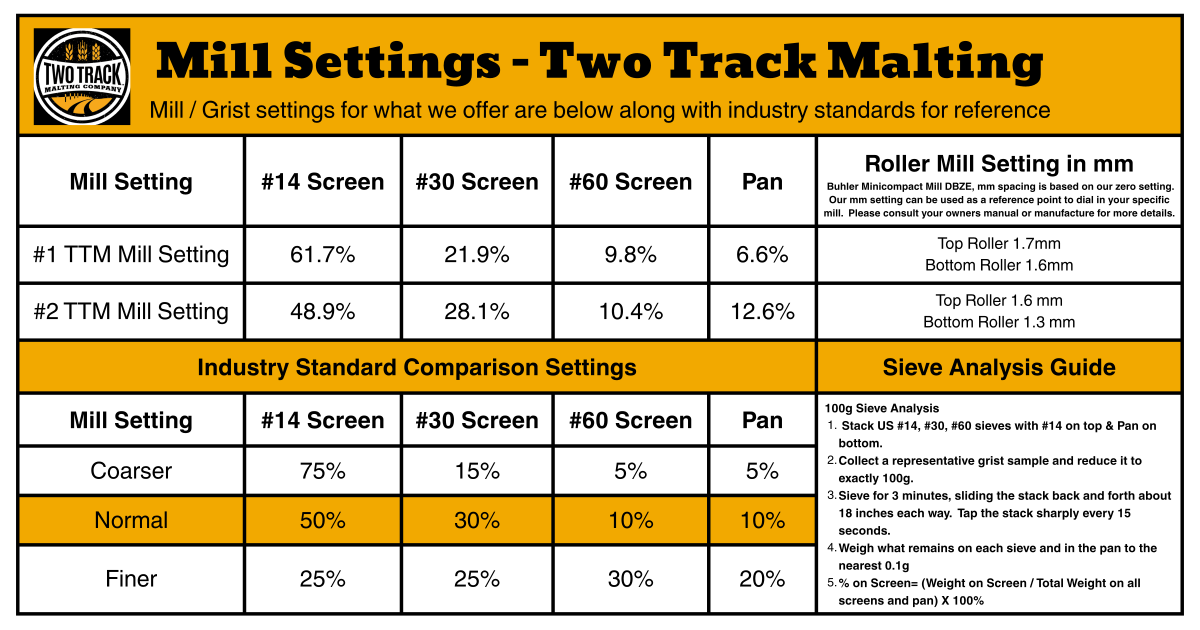
One of the most common questions we receive from customers is why is extract or gravity is lower during the brew. This is usually related to the mill gap setting on your mill. We use our own proprietary barley variety in our malts and just because the mill setting you have has worked with other malts doesn’t necessarily mean it will work perfectly with our malt. One thing that brewers must be aware of is that each crop year, malt supplier, and barley variety will have slight variations and staying vigilant with your mill can ensure you are hitting your numbers and improving efficiency at the brewhouse.
In conjunction with looking at your malt COA’s and reviewing your grist coming out of the mill you can make slight changes to improve efficiency, consistency, and ensure you are utilizing your ingredients to their fullest potential. The tools you will need to maximize your mill are usually already available to you. A gram scale, set of sieves, feeler gauges, and about 5-10 minutes can provide you with detailed information to make informed adjustments to the mill. If you don’t have a sieve kit you can purchase what you need below. This simple test is well worth the $80-120 investment that can save you thousands in the long run.
#14 Mesh Sieve
#30 Mesh Sieve
#60 Mesh Sieve
Pan
Sieve Analysis Steps
1. Measure and record the mill gaps using a feeler gauge
2. Mill some malt and collect a representative sample of 100g
3. Stack #14, #30, #60 sieves with #14 on top and pan on bottom
4. Sieve for 3-5 minutes, sliding the stack back and forth about 18 inches each way. Tap the stack sharply every 15 seconds.
5. Weigh what remains on each sieve and int eh pan to the nearest 0.1g
6. % on Screen = (Weight on Screen / Total Weight on all screens and pan) X 100%
Once you have the numbers you can enter those in the calculator below.
Malt Mill Sieve Analysis Calculator
Understanding the Results
Each brewer’s equipment handles milled product differently so dialing it in for your specific system will always improve results. A mill is not a set it and forget it piece of equipment and you want to check it on a regular basis. Running a sieve analysis you allow you to catch issues before they start affecting the brew day.
If you are having slow runoff, lauter bed compaction, increased mash viscosity, or the dreaded stuck mash then that is usually an indication that the mill is having excessive fines and you will need to increase the mill gap slightly.
If you are experiencing lower extraction efficiency, lower gravity readings, or higher residual starch this indicates higher #14 (coarse) retention and reduced fine grits and you will need to tighten the mill gap slightly.
The concept is the same for 2 or 4 roller mills but keep in mind on 4 roller mills you will want to run a sieve test each time you adjust the top or bottom rollers to make sure your adjustments are delivering the results you are looking for.